
The Economics of Sales Productivity
Small operational improvements can create significant commercial impact at enterprise scale.
Explore how well-designed sales tools help organisations recover selling time, improve consistency, reduce unnecessary complexity, and support more effective sales execution.
Small improvements compound quickly
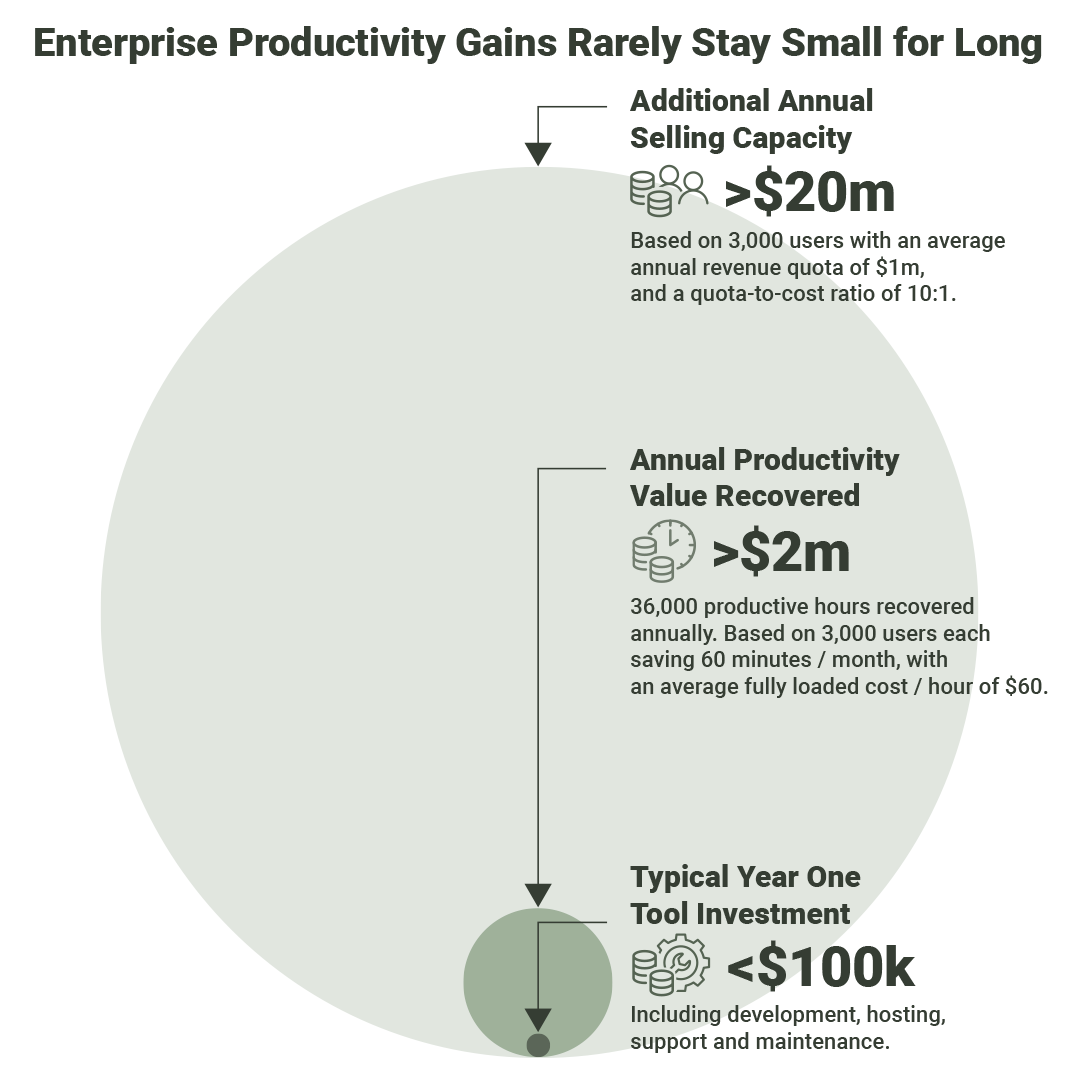
In complex sales organisations, small delays, inefficiencies, and inconsistencies can multiply across thousands of users, opportunities, and customer interactions.
Well-designed sales tools do more than improve process. They help sales teams work more effectively, reduce unnecessary effort, improve consistency, and respond faster when priorities change.
Most productivity gains do not come from one large transformation initiative. They come from small operational improvements repeated consistently across large sales ecosystems.
Reducing the time spent configuring products, preparing proposals, searching for information, or managing manual administration may appear minor in isolation, however, across large organisations and partner networks, those gains compound quickly.
Recovering just 1% of 100 salespersons’ working day is effectively the equivalent of adding an extra salesperson to your team. Demonstrating that at enterprise scale, relatively small improvements create substantial additional sales capacity.
Where the value comes from

Sales productivity improvements generally create value in three ways.
First, through time recovered. Reducing the effort required for routine sales activities allows sales teams to spend more time focused on customers, opportunities, and revenue-generating activity.
Second, through cost avoidance. Well-designed tools help reduce duplicated effort, manual administration, errors, and operational overhead created by disconnected or difficult-to-manage processes.
Third, through improved commercial effectiveness. Faster response times, better proposal quality, improved consistency, and clearer positioning all contribute to a stronger sales experience for both customers and partners.
Not all benefits are easy to measure

Not every benefit can be reduced to a direct financial calculation. In many organisations, the broader operational impact is equally important.
Well-designed sales tools can help improve consistency across global sales teams and partner networks, support brand integrity, improve adoption by making systems easier to use, and help partners position solutions more confidently in competitive sales environments.
They can also reduce dependency on individual knowledge, simplify onboarding, and help organisations adapt more effectively as priorities, products, and structures evolve.
The hidden cost of complexity

Many organisations also carry hidden operational dependency within spreadsheets, macros, disconnected tools, and manual workarounds that were originally created to solve immediate business needs.
Over time, these solutions evolve through changing requirements, multiple owners, and incremental fixes. Eventually becoming business-critical, even though they were never designed to support that level of dependency.
The issue is rarely the individual solution itself. The challenge is accumulated complexity, loss of clarity, and processes that have become difficult to maintain or fully understand.
In many situations, the right starting point is not analysing the existing tool in detail, but stepping back and redefining what the business process actually needs to achieve today.
Why simpler tools are often more effective

One of the most common misconceptions is that improving sales productivity always requires large-scale transformation programmes or highly complex technology platforms.
In practice, many of the most effective improvements come from focused tools designed around specific business requirements and operational objectives.
Simple, well-targeted tools are often more effective, easier to maintain, and more widely adopted than overly complex platforms attempting to solve every possible use case.
When implemented well, relatively modest investments can create substantial operational and commercial value over time. In many cases, the annual cost of supporting and evolving an effective sales tool is lower than the cost of a single full-time salesperson, while the productivity benefits extend across entire sales teams and partner networks.
Long-term value comes from continuous improvement

The value of sales tools is not determined by the technology itself.
It comes from how effectively the tools support the operational reality of the business, reduce unnecessary effort, improve consistency, and help sales teams work more effectively over time.
In large sales organisations, productivity is rarely transformed through a single initiative. It improves through continuous refinement of the workflows, tools, and processes that sales teams rely on every day.
That is where the economics of sales productivity become meaningful.